Live Network Map DEMO
Law enforcement
Public works
Code enforcement
Citizen-owned transparency technology
What if Flock worked in reverse, tracking government vehicles, locations, timestamps, plates and more, but collecting NO data about private citizens? Let's build it!
Interactive concept
Everything in this section is simulated. Click a demo marker or detection card to explore the proposed interface.
Citizen-owned infrastructure
A WatchBack participant could mount a compatible camera on private property with a view of a public roadway or other publicly visible government activity.
The proposed WatchBack Edge Node processes the camera feed locally and is intended to report only relevant configured events instead of continuously uploading ordinary traffic.
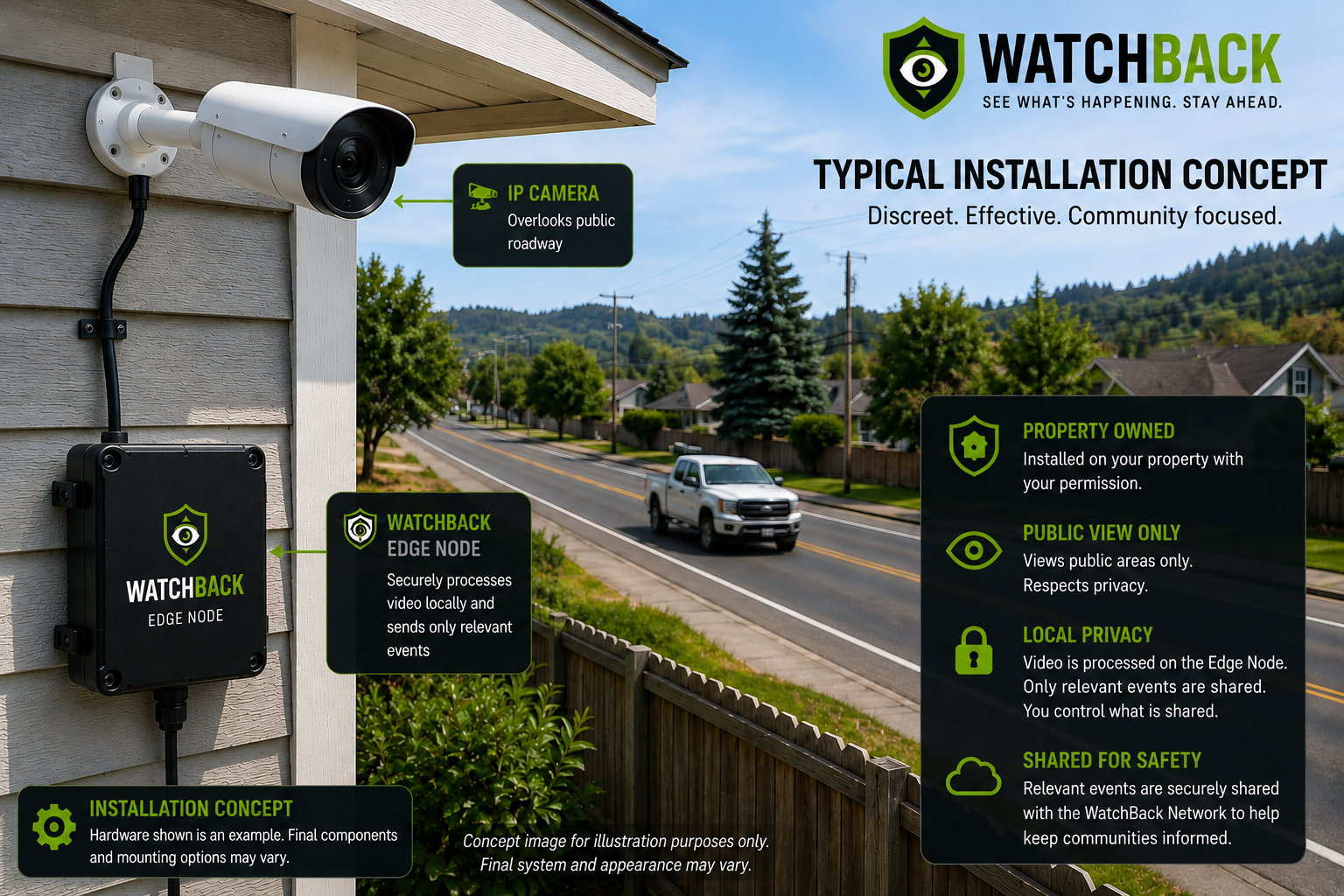
A people's infrastructure
The concept is simple: observe locally, process locally, report selectively, and make relevant public information useful.
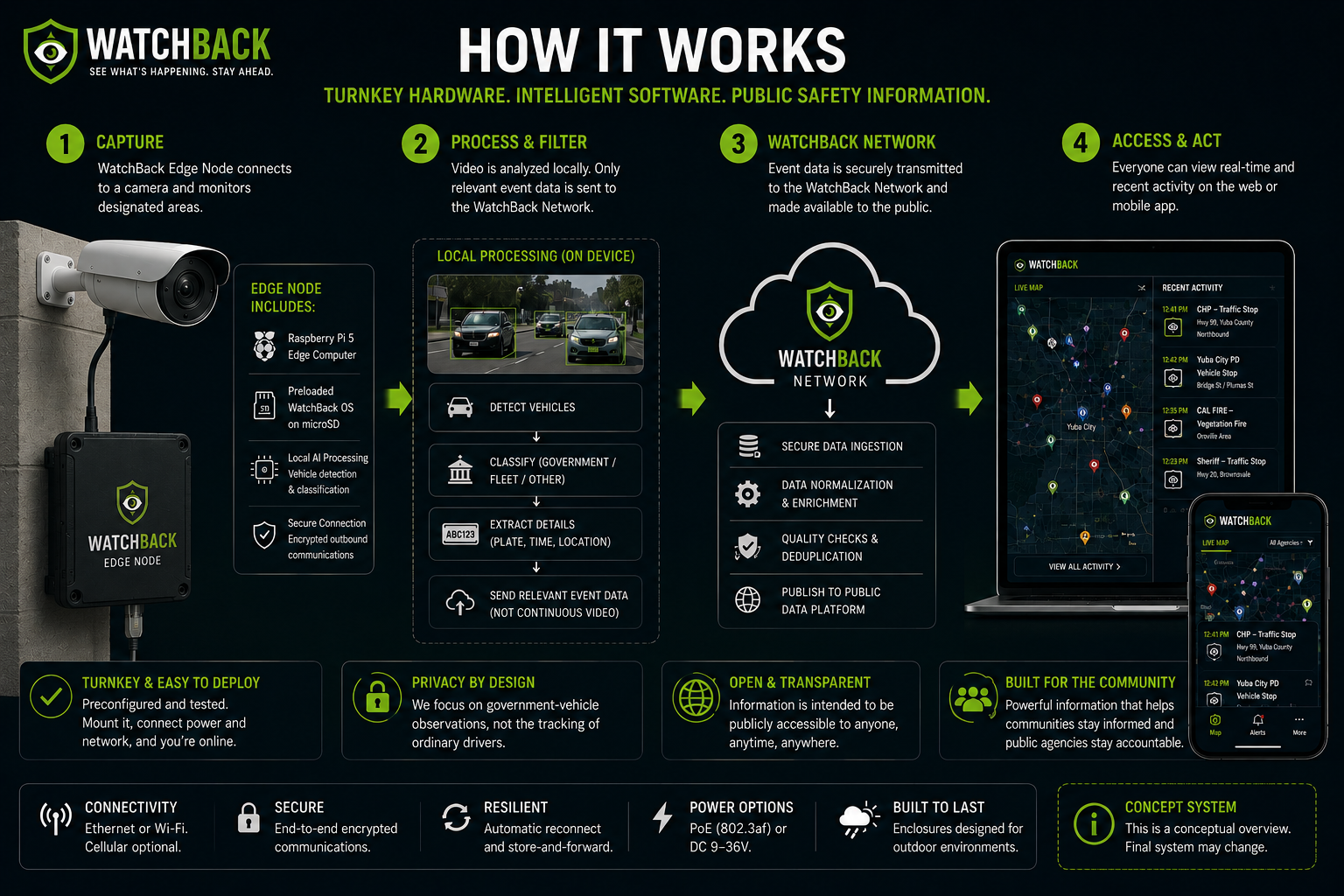
A participant places a compatible camera on property they control, aimed only where lawful.
The Raspberry Pi analyzes video on-device and looks for publicly identifiable government vehicles.
Non-target traffic is intended to be discarded locally instead of uploaded to WatchBack.
A qualifying observation can generate a small event record containing only configured public-facing data.
Approved data could appear in WatchBack Live and mobile apps under the project's final legal and privacy rules.
Turnkey hardware
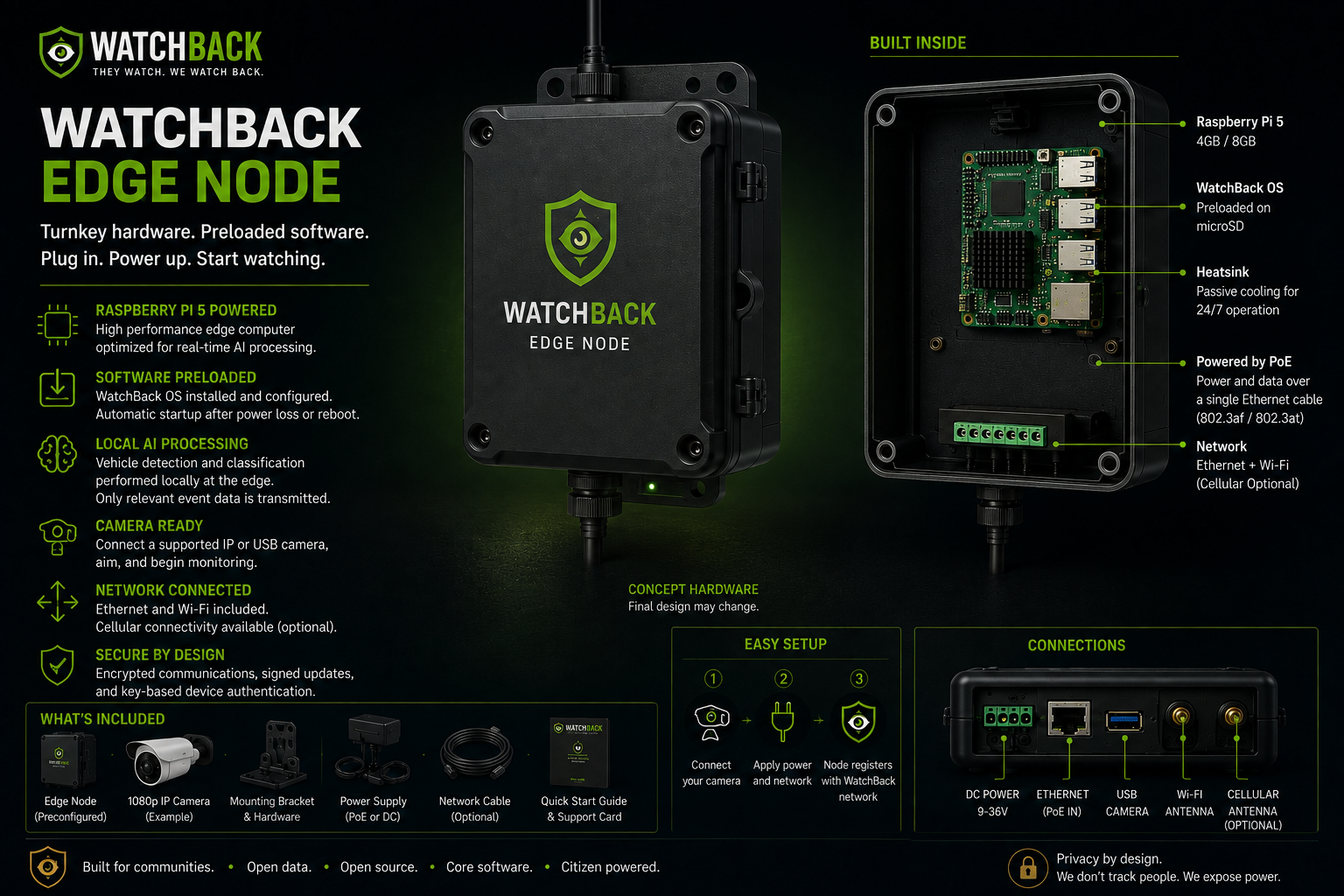
The first WatchBack prototype is being built around a Raspberry Pi edge computer running preconfigured WatchBack software.
The goal is to prove the core idea with real hardware: detect publicly identifiable government vehicles locally, discard ordinary traffic, and make the system simple enough to run without requiring the user to configure a Raspberry Pi from scratch.
Be one of the first to help fund WatchBack and plant the seed for the first working prototype.
Edge AI software
The proposed WatchBack software runs locally on the Raspberry Pi Edge Node. Video is analyzed at the camera site so ordinary traffic does not need to be continuously uploaded to a central server.
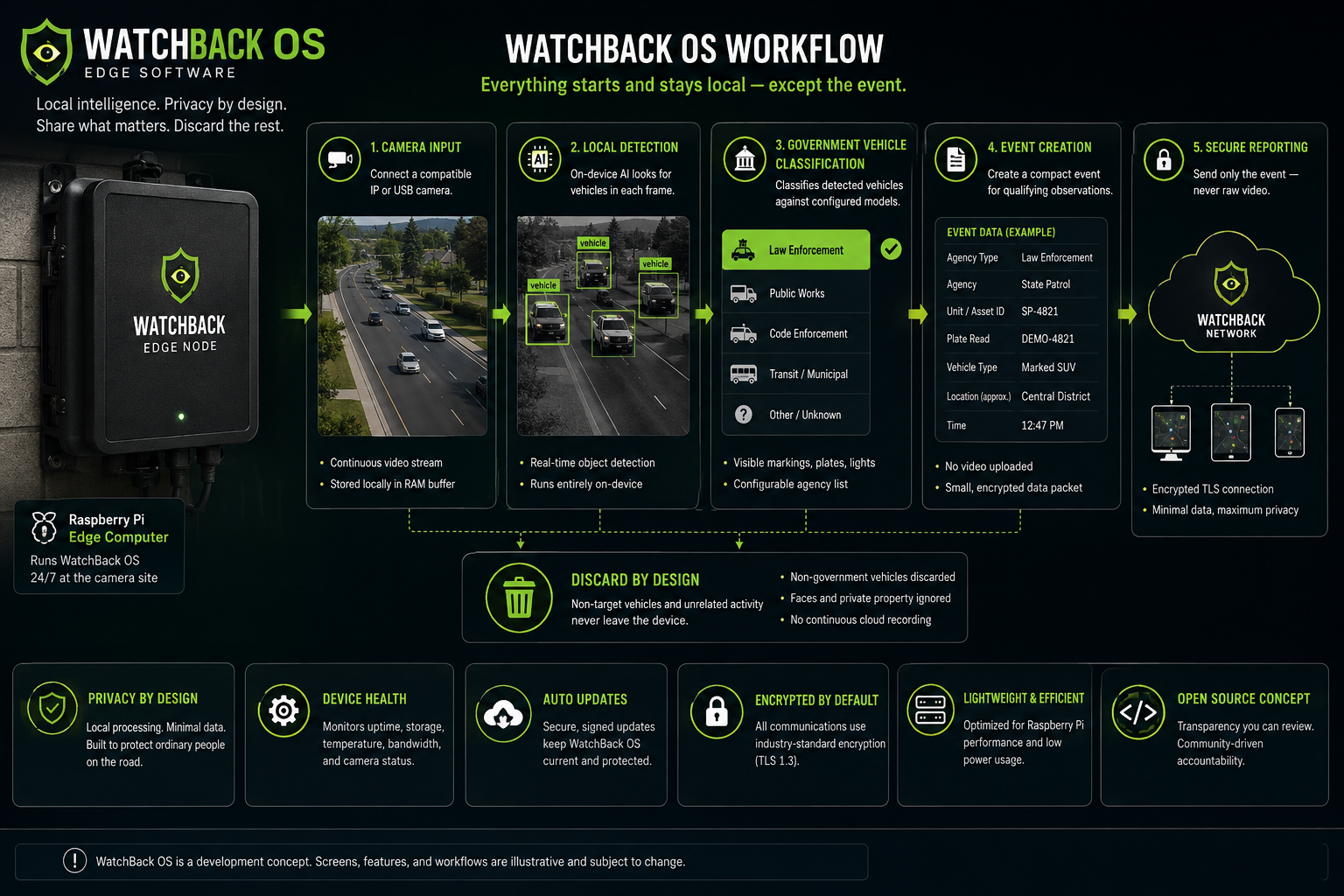
Camera video is analyzed on the Edge Node instead of being continuously streamed to WatchBack servers.
The system is intended to identify configured classes of publicly identifiable government vehicles while rejecting ordinary traffic.
Qualifying observations can be converted into small event records containing only the information required by the network.
Non-target observations are intended to remain local and be discarded rather than becoming part of a centralized record of ordinary drivers.
Bring your own camera
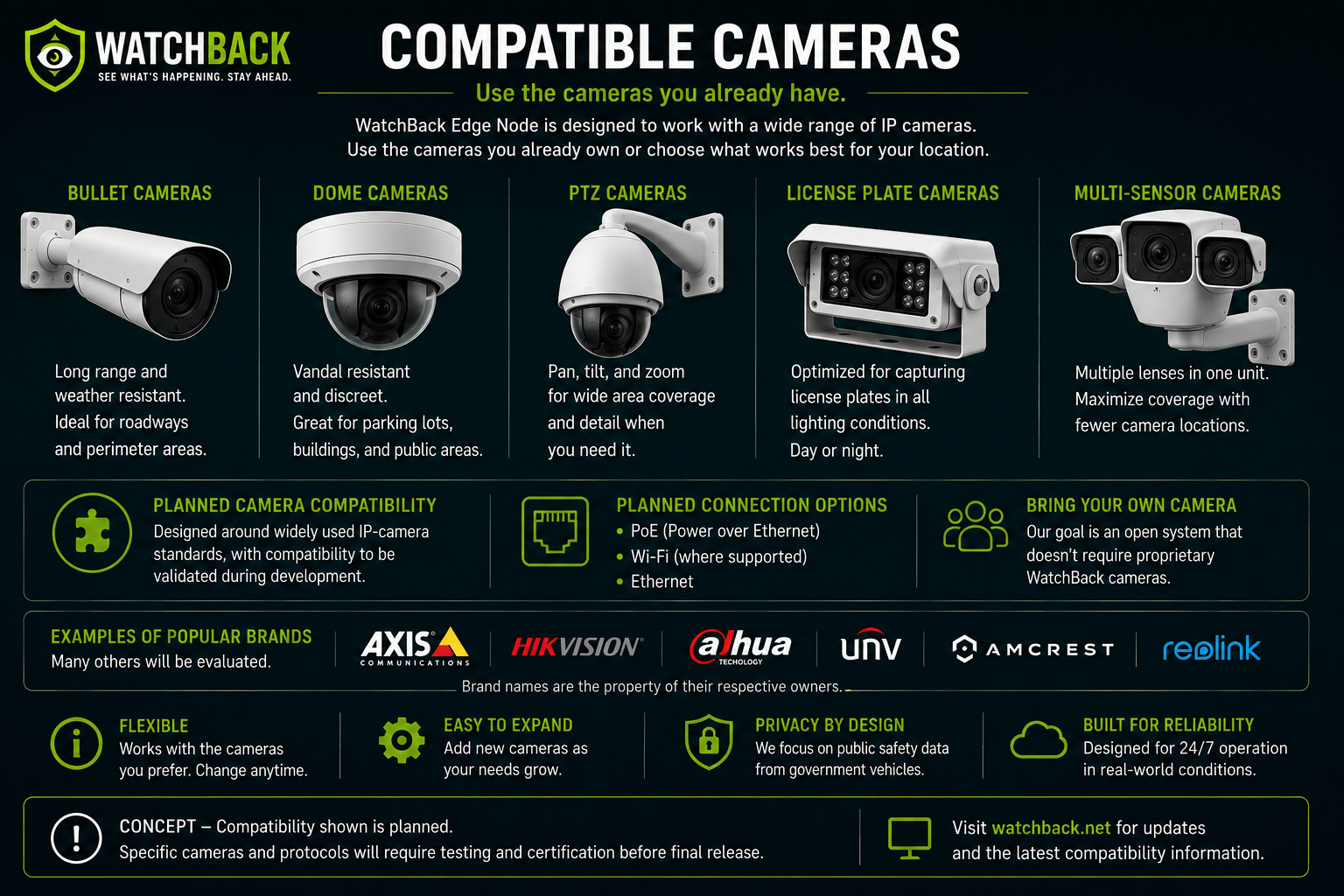
WatchBack is intended to work with commonly available camera hardware instead of forcing participants to purchase a proprietary WatchBack camera.
Compatibility is still a development goal. Specific camera models, protocols, and connection methods will need to be tested before a final compatibility list can be published.
Mobile
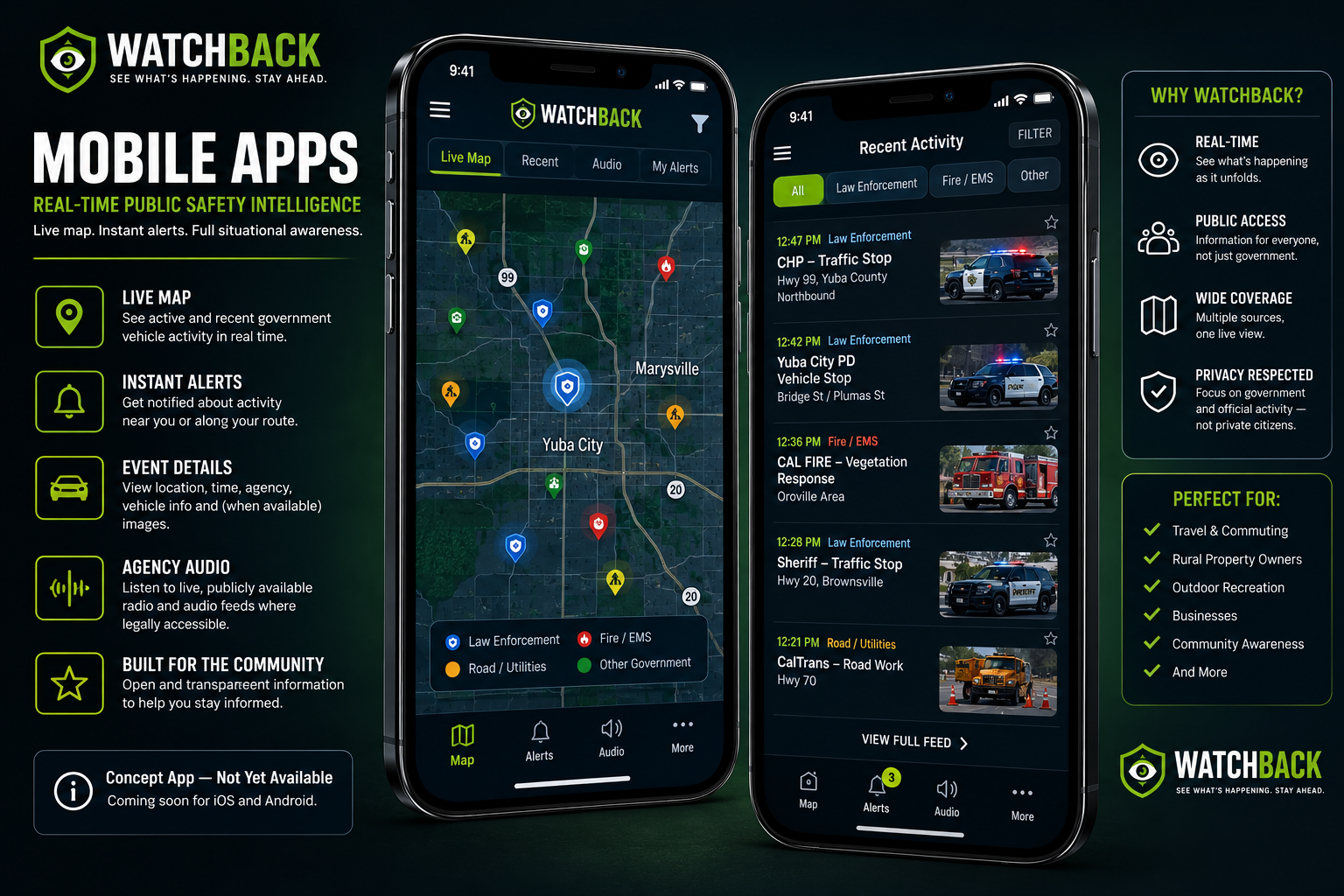
The proposed iPhone and Android apps would make WatchBack observations available through a map, recent activity feed, alerts, agency information, and other public-facing tools.
Legal foundation
WatchBack is still a development concept. These authorities are part of the legal foundation being researched; they are not a guarantee that every proposed feature is lawful in every jurisdiction.
Why WatchBack?
Governments and private vendors have spent years building tools that can observe activity on public roads. WatchBack explores what a citizen-owned, privacy-conscious transparency network could look like when those same classes of technology are pointed toward publicly visible government activity.
The project is deliberately designed around a narrower goal: identify government activity of legitimate public interest while avoiding indiscriminate collection of ordinary people's movements.
Help build WatchBack
WatchBack is still in development, but the concept is real and the next steps are clear: software development, prototype hardware, security testing, infrastructure, mobile apps, and specialized legal review.
Those things cost money. Early support helps turn WatchBack from a working concept into something that can actually be built, tested, and launched.
Even $5 helps. Please do not contribute more than you can comfortably afford. There is no minimum amount required to support the project, and every contribution helps move the work forward.
If you believe the public should have better tools for transparency, this is one way to help make that possible.